


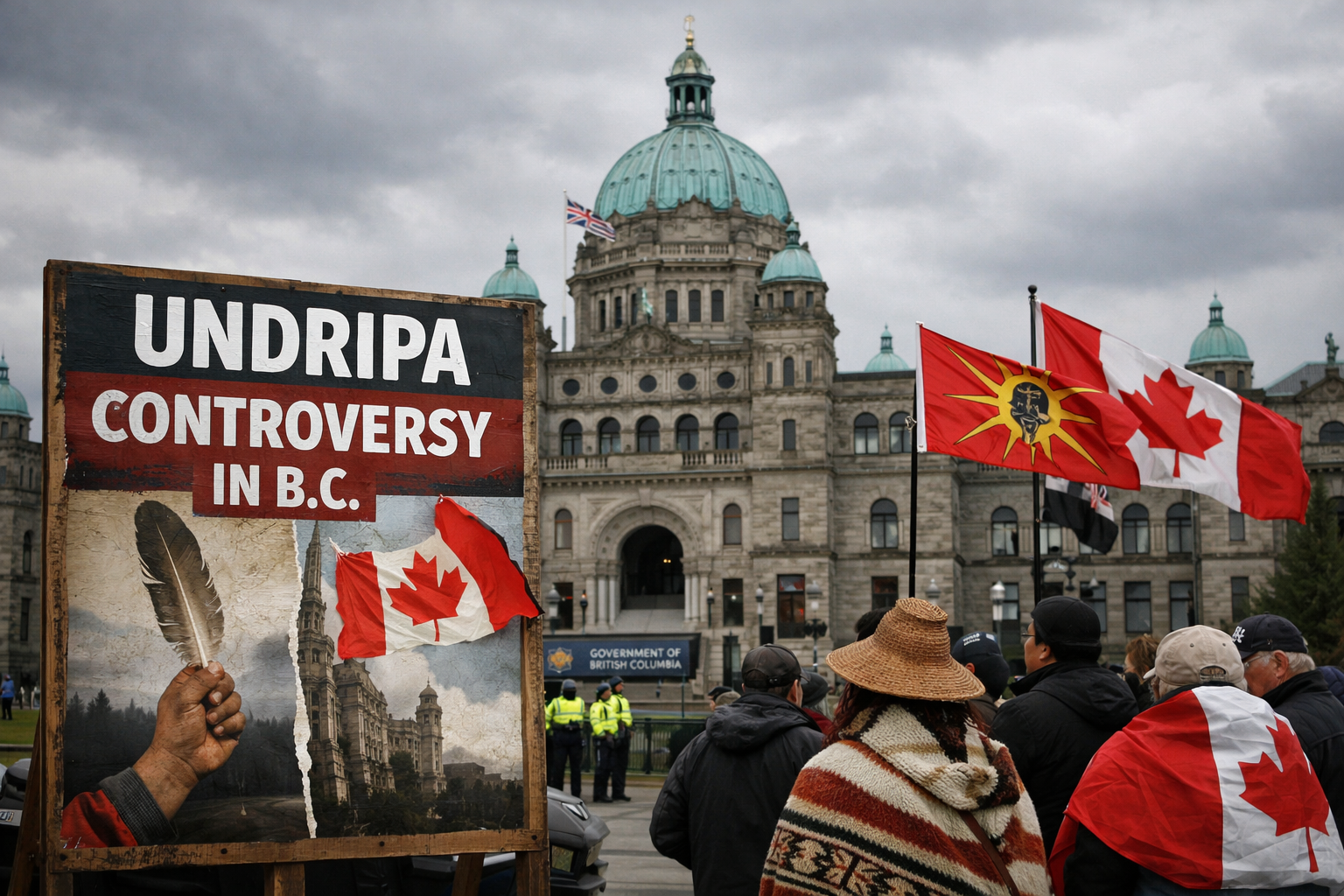
“The Shifting Ground: DRIPA, the Courts, and the Unraveling of Old Certainties in British Columbia”
British Columbia, a province carved by mountains and memory, has found itself once again in the crosscurrents of history, law, and land. What once seemed settled—the dominion of the Crown, the primacy of private property, the predictable machinery of government—has become uncertain, and the tremors are increasingly felt in courtrooms, boardrooms, and backyards alike.
This unease, as palpable as the rain that soaks the Pacific coast, has a name: DRIPA, the Declaration on the Rights of Indigenous Peoples Act, passed in 2019 and now fully activated by the provincial government. As with so many high-minded ideals transcribed into law, its consequences, intended or not, are becoming more evident—and more explosive.
A New Legal Order, Quietly Born
“Change,” once observed of another era, “came not with a roar but with a shuffle of papers.” So it has been in British Columbia. When the New Democratic Party government adopted DRIPA, aligning provincial law with the United Nations Declaration on the Rights of Indigenous Peoples (UNDRIP), they hailed it as a landmark moment in reconciliation. “It’s about doing things differently,” said Premier John Horgan at the time.
But different is not always better—at least not for all. In 2023, Gitxaala v. British Columbia (Chief Gold Commissioner) shook the legal landscape, with the B.C. Supreme Court rebuking the province for failing to consult Indigenous groups on mineral claim registrations. The ruling signaled a sharp shift: old assumptions about Crown land, resource rights, and private initiative were no longer safe.
Legal scholar Dwight Newman warns, “DRIPA explicitly requires that all B.C. laws be made consistent with UNDRIP, and that includes implications for consent and veto rights.” (Newman & Renwick, 2025). This is not a footnote—it’s a rewriting of the rulebook.
The Rise of Consent: From Consultation to Veto?
The cornerstone of UNDRIP, and therefore DRIPA, is “Free, Prior, and Informed Consent” (FPIC). Under the old regime, governments needed only to consult First Nations before approving projects that affected their rights. Now, increasingly, consent must be obtained—effectively giving Indigenous communities a veto over land use decisions.
This is where the machinery of government and the logic of the market begin to shudder. In 2024, as the province moved to amend the Land Act to implement shared governance over Crown lands, it sparked panic in rural municipalities and legal scholars alike. The Fraser Institute’s David Allen warned that these changes introduced “transaction costs so high, they threaten the operability of land markets in B.C.” (Allen, 2025).
Put plainly: who owns the land? Who has the right to decide what can be done with it?
These questions, once considered answered in 19th-century treaties or 20th-century zoning laws, are now being reopened with 21st-century urgency. This uncertainty is not merely academic. It is destabilizing investment, halting development, and turning what were once routine business operations into constitutional quagmires.
Private Property Under Siege
The principle of private property, that cornerstone of liberal democracies, is now in question. Not directly—no one has yet seized a farm or revoked a land title—but the legal and regulatory fog surrounding land use has made property rights feel provisional.
As M. Vijairaghavan (2025) noted, “In regions where consent-based agreements exist under DRIPA, local planning authorities and private developers have found themselves frozen—waiting for permissions that may never come.” Projects worth billions have stalled, from clean energy sites to forestry plans, because of ambiguous governance structures.
In the words of a frustrated mayor in northern B.C., quoted in The Globe and Mail, “We don’t know who to ask, and we don’t know who can say yes.”
The Fragmentation of Sovereignty
This, perhaps, is the deepest undercurrent: a reconfiguration of sovereignty itself. Under DRIPA, the Crown is not simply sharing power—it is, in some interpretations, ceding it.
In practice, many Indigenous Nations are asserting jurisdictional authority over their territories. Some have begun drafting their own land codes, legal systems, and environmental regulations. This is not merely symbolic. These governance structures have the potential to supersede provincial law, creating a layered—and conflicting—system of legal authority.
Legal scholars like S. Wood (2025) speak of “legal pluralism,” but business leaders and local officials call it legal chaos. As the Canadian Journal of Political Science reports, the implementation of DRIPA has created a situation where “legal obligations and political authority are increasingly fragmented across non-aligned systems of governance” (Côté et al., 2025).
Conclusion: A Province at the Crossroads
What does all of this mean? For Indigenous peoples, it is a long-overdue recognition of inherent rights and a powerful tool to protect land and culture. For the province, it is a bold attempt to reconcile with history—and to fulfill moral and legal obligations.
But for the rest of British Columbia, the consequences are more complex. Planning has become precarious. Investment is cautious. The rule of law—once thought to be a settled framework—is now a shifting target. Private property, once secure, now lives under a cloud of contingent legitimacy. Sovereignty, once unitary, now feels shared or split.
The tension was perhaps inevitable. As was written in the twilight of empire, “When the assumptions of centuries are undone, the noise is not a bang, but a shiver through the walls.”
British Columbia has entered an era where the old walls—legal, institutional, even constitutional—are shaking. Whether this becomes collapse or renewal will depend not on declarations, but on deeds.
Works Referenced
- Newman, D.G., & Renwick, J. (2025). Uses and Abuses of UNDRIP in Canadian Courtrooms. SSRN.
- Vijairaghavan, M. (2025). A Patchwork of Promises: Implementing Free, Prior, Informed Consent in Canadian and British Columbia Impact Assessments. University of Calgary.
- Allen, D. (2025). Transaction Cost Problems with Amending the Land Act for Shared Ownership. Fraser Institute.
- Côté, I., Grant, J.A., Mitchell, M.I., & Panagos, D. (2025). Trailblazers and Laggards: Explaining Variation in UNDRIP Implementation at the Subnational Level in Canada. Canadian Journal of Political Science.
- Wood, S. (2025). Environmental Rights and Canada’s Constitutional Cul-de-Sac. Review of Constitutional Studies.